

What Is Needed To Register A Vehicle In A Company Name? North Carolina
| Denver, North Carolina | |
|---|---|
| Demography-designated place | |
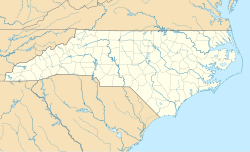
| Denver Show map of Due north Carolina Denver Show map of the United States | |
| Coordinates: 35°31′52″Due north 81°01′43″W / 35.53111°Northward 81.02861°W / 35.53111; -81.02861 Coordinates: 35°31′52″N 81°01′43″W / 35.53111°N 81.02861°Westward / 35.53111; -81.02861 | |
| State | United States |
| State | North Carolina |
| Canton | Lincoln |
| Area | |
| • Full | 5.93 sq mi (fifteen.37 km2) |
| • State | 5.93 sq mi (xv.35 kmii) |
| • Water | 0.008 sq mi (0.02 km2) |
| Superlative | 902 ft (275 m) |
| Population (2010) | |
| • Total | 2,309 |
| • Density | 390/sq mi (150.iv/kmtwo) |
| Time zone | UTC-5 (Eastern (EST)) |
| • Summer (DST) | UTC-4 (EDT) |
| Zero lawmaking | 28037 |
| Expanse lawmaking(s) | 704 |
| FIPS code | 37-17000 |

Denver, formerly known as Dry Pond, is a census-designated place and unincorporated community in Lincoln County, North Carolina, United States.[1] As of the 2010 census it had a population of two,309.[two]
Geography [edit]
Denver is situated on Due north Carolina Expressway 16 west of Lake Norman. It is nigh 25 miles (forty km) north of downtown Charlotte and fifteen miles (24 km) southeast of Newton. Denver'south northern edge is the Catawba Canton line.
According to the U.Southward. Demography Bureau, the Denver CDP has a full expanse of five.9 square miles (15.four kmii), of which 0.01 square miles (0.02 km2), or 0.14%, are water.[3]
Denver'southward ZIP code is 28037. The elevation is 902 feet (275 chiliad) to a higher place ocean level.
Demographics [edit]
The demography[four] of 2000 for Denver's cypher code 28037 shows a total population of 13,030 with a median age of 41 years. The racial makeup was 83.9% White, v.viii% African American, and one.five% other races. There were 5,052 households, 77.5% being family households. The average household size was 2.56 people. 82.9% of the residents had a high school education or higher, and 20.4% had a Available's Degree or higher.
lxx.7% of residents over 16 were employed, with 84.vii% of those commuting to piece of work alone in a vehicle. The largest employers were Manufacturing at 20.two%, 'Transportation and warehousing, and utilities' at 11.half-dozen%, and Construction at 10.0%. The median household income was $52,304. 3.7% of families were below the poverty line. The median house value was $162,000 with 75.8% having a mortgage, contract to purchase, or similar debt.[v]
History [edit]
Period of foundation [edit]
The community of Dry out Swimming derived its name from a small pond, which once stood at what is now the corner of Highway 16 Business and Campground Route, at present the site of the local First Federal branch. The pond would dry up in the heat of summer months.
18th century [edit]
Adam Sherrill and his family first settled in the expanse in 1747, and they were followed by John Beatty two years later. The bodily location of Denver was kickoff settled effectually 1770. People of Scotch-Irish and German descent from Pennsylvania, were among the showtime white settlers. Most of the early on Scotch Irish were Presbyterians, and their first place of worship in what would go the Denver area was John Beatty'southward business firm, which was located about i mile west of Beatty'due south Ford, near the present-24-hour interval Triangle customs. Now known equally Unity Presbyterian, the first meetinghouse for this congregation was originally built of logs. In 1808, it was decided to erect a larger building, and a plot of several acres was conveyed for the purpose past James Fiddling to "James Connor, Alexander Brevard, John Reid and Joseph Graham, trustees." Dr Humphrey Hunter, a native of Republic of ireland and a soldier in the American Revolutionary War, was pastor from 1796 to 1804. Next came Rev. Henry N. Pharr. He was succeeded by Patrick Sparrow, whose father was a potter at Vesuvius furnace, part of the Graham family'due south local iron industry. Sparrow was the showtime professor of languages at Davidson Higher, and afterwards president of Hampden–Sydney College in Virginia. A long-time minister at Unity was Robert Hall Morrison, who was first president of Davidson College.
The Presbyterians were presently joined past early on Methodists from Maryland, who initially took upward residence near what is at present Terrell. Longtime leaders of the Methodists in the region were Rev. Daniel Asbury and Rev. Jeremiah Munday, pioneer Methodist ministers. When he was younger, Asbury traveled to Kentucky with some family unit members (amongst them the Callaways) and, forth with their leader Daniel Boone, he and approximately twenty men were taken hostage past a band of Shawnee. They were carried to the far northwest (nowadays-day Ohio) and held in captivity for five years. Asbury later was traded to the British in what is now Detroit, and returned to his habitation in Virginia. In 1791, Asbury established in Lincoln County the first Methodist church due west of the Catawba River, which is now known as Bethel United Methodist Church. Rev. Jeremiah Mundy was a native of Virginia and came to Lincoln County in 1799. He was a soldier in the Revolutionary War 3 years and a minister for 35 years. These Methodists brought with them the institution of "camp coming together", which chop-chop became 1 of the nearly important traditions for the region. Interdenominational from the beginning, the local Rock Springs Camp Coming together grows out of these early meetings and traces its history to 1794, when Daniel Asbury, William McKendree (who would become a bishop), William Fulwood and James Hall, a Presbyterian, held the offset gathering near nowadays-day Rehobeth Church in Terrell.
Native Americans [edit]

Nearly of the land that these Europeans claimed had long been the home of the Catawba and Cherokee people. The Catawba River in this part of North Carolina acted as a border between the two nations, who were frequently at odds with each other. In the earliest days of European settlement, in that location were episodes of violence between the Native Americans and the new settlers, and eventually a fort was synthetic near present-twenty-four hour period Statesville to help provide a level of defense for the western portion of the colony.
General William Lee Davidson [edit]
On Feb ane, 1781, British forces under the control of Lt. General Cornwallis clashed with North Carolina troops led by Brig. Gen. William Lee Davidson at Cowan's Ford, the southernmost limit of present-day Denver. The British were pursuing Nathanael Greene's forces following the Patriot victory at Cowpens, South Carolina, and Davidson'southward men had been sent to stall and harass his advance. With Davidson was Helm Joseph Graham, a local, who had raised 56 cavalrymen. He had promised that those who furnished their own horses and equipment and served six weeks would be considered every bit having served a tour of three months.
Local blacksmiths made 45 crude swords for the new mounted troops. Only fifteen of Graham's men had pistols, but all had rifles, non the platonic weapon for horseback fighting. Davidson, charged with guarding four of the Catawba River crossings, had sent 500 men to Beattie's Ford, keeping merely 25 at Cowan'southward. But the river was high and Cornwallis did not have access to his heavy guns. Led past a local Tory guide, Frederick Hager, the British began to cross the river early as the Americans were still sleeping. The sentry was non alerted until Cornwallis' troops were inside 100 yards of the shore. The battle began, and the strong electric current was on the American's side. Greatly outnumbered, the local forces were able to hold their own, slowly falling back into the woods while returning fire. The British finally took the ford and advanced. General Davidson was shot, and the militia, seeing this, fled. Major Graham's cavalry covered their retreat. The battle had helped a larger force under the command of Daniel Morgan attain the Yadkin River unopposed. It is said that Frederick Hager was the man who shot the gun that killed General Davidson.
19th century [edit]

Etching of the Lincolnton Cotton fiber Mills in 1813, the first cotton manufactory in North Carolina
Most of the early settlers were subsistence farmers who relied heavily upon hunting to supplement their tables. Grist mills and saw mills were among the first local industries, just the production of iron before long became the biggest industry for the expanse. By 1810, Lincoln County boasted six ironmaking operations, including Vesuvius, Mt. Welcome, Mount Tirzah, Mountain Carmel, High Shoals, and Madison. A number of individuals and partners took the atomic number 82 in establishing ironworks in eastern Lincoln County, well-nigh merely to the west of present-day Denver, virtually Pumpkin Heart and in the direction of Iron Station. The partnership of Peter Forney, Joseph Graham, John Davidson, and Alexander Brevard was responsible for the construction of Vesuvius Furnace in 1795. Peter Forney built Madison Iron Furnace along Leeper's Creek in 1809. These two sites, like other local ironworks, changed hands at diverse points. Other individuals involved in the development of the fe industry in Lincoln County include Turner Abernethy, John Fulenwider, Dr. William Johnston, Jonas W. Derr, and J.F. Reinhardt. James Madison Smith later erected Stonewall Furnace in 1862 to help meet the need for fe brought on by the Civil War. Operations at Rehoboth (begun in the 1820s) and Madison furnaces also resumed during the turbulent years from 1862 to 1865 to supply much-needed iron for the Southern state of war effort.
Dry out Pond [edit]
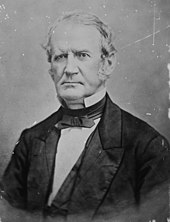
William Alexander Graham (September 5, 1804 – August 11, 1875), a Denver native. United states senator from Northward Carolina from 1840 to 1843, governor of North Carolina from 1845 to 1849, and United States Secretary of the Navy from 1850 to 1852.
There was a Dry out Swimming Post Office outset right before the Ceremonious War, although information technology moved across the line to Catawba County about what is at present Kiestler's Store Road in December 1868. In 1873, in an endeavor to concenter a railroad spur and thinking that the moniker "Dry out Swimming" didn't present a dainty plenty prototype for the railroad planners, headmaster of the local Stone Springs Academy, D. Matt Thompson, led the effort to accept Dry out Pond renamed for the capital of Colorado, which was just then petitioning for statehood.
In the years before the Civil War, North Carolina'due south wealthy class in need of a break from the summer rut, could escape to Lincoln County's Catawba Springs resort. The popular antebellum destination, named for the Catawba people formerly living in the area, was built amidst seven mineral springs almost Denver. Guests vacationed there as early as the 1790s. In 1824, geology professor Denison Olmstead recommended the waters of the springs for complaints concerning the liver and weakness. At that place is piffling bear witness that healing actually occurred; withal Catawba Springs became a pop terminate on the stagecoach lines from Salisbury to Asheville.
Revolutionary State of war veteran and state legislator Helm John Reid was the kickoff known proprietor of Catawba Springs. After his death in 1821, the spa passed through a serial of owners: Charles Jugnot, William Simonton, and Joseph Hampton. In 1838, Hampton renovated and expanded Catawba Springs, including the construction of a two-story, 100-room hotel. After the renovation, during parties and on holidays, as many equally 500 guests assembled on the porch of the hotel. Before that time, the spa could simply accommodate lx to seventy guests in its cabins. Nigh guests were members of the southern planter class from North and S Carolina. Amid the names of prominent North Carolina families listed in the hotel records are the Grahams, Brevards, Alexanders, Caldwells, Davidsons, and Polks. Some guests made their fashion to the spa from Mississippi, Alabama, and Louisiana. Students from nearby Davidson Higher could also be found enjoying themselves there on the weekends. During the early 1840s, Peter S. Ney ran a school for boys at the resort known equally Stewart'due south Seminary.
American Civil War [edit]
During the Civil War, the local area raised two units for the Confederacy. In March 1862, a group of local men, most of whom were related, formed a visitor known as the "Dry Pond Dixies" (Company 1000, 52nd regiment of Due north Carolina Troops) and joined the Confederacy. Added to their number were a number of Quakers from Randolph County, who did not fight but helped with the wounded. The other group was known equally the Beatty'due south Ford Rifles (Company K 23rd Regiment).
The Ceremonious War put an end to the southern planter aristocracy, and with its patron base depleted, Catawba Springs closed in the mid-1860s. By the time North Carolina had begun to recover from the devastation of the state of war, railways and eventually practiced highways, had led to the opening of mount resorts. (A similar, but unrelated, resort operated under the name Sparkling Catawba Springs in Catawba County during the latter part of the nineteenth and early on twentieth century.) The buildings, were demolished in 1930, and the springs now bubble invisibly into a farm pond. A faint, lingering scent of sulfur is all that remains.
Town Incorporation [edit]
In October 1874, Denver'south first postmaster, John A. Kids, was appointed. Mail to the Catawba Springs post role was transferred to the Denver post office the next twelvemonth. Two years later, the community was incorporated every bit a town by the state of North Carolina. Unfortunately for the citizens of the area, the railroad chose not to run through the growing small boondocks, and information technology began to dry upward like the swimming for which information technology was originally named.
For much of its existence, "downtown" consisted of a few houses, a handful of stores, a couple of churches, a school, a barber shop, a post office, a bank, and a cotton gin. The 1902 Soil Survey map of the Hickory, North Carolina surface area, shows Denver having a small grid of streets running along what are now Highway 16 Business and Campground Road. By 1914, the soil survey map of Lincoln County showed only a grid of three short streets running northwest to southeast parallel to what is now Highway 16 Business and one street running parallel to Campground Road (which yet exists and was chosen by locals for many years "Back Street"). Apparently, i of the short streets perpendicular to Campground Road ran beside what is now the phone building on St. James Church Route, and another of these perpendicular streets connected to what is now Campground Road correct at the Rock Springs Campground. Some other office of the "street filigree" for Denver was Cemetery Route. It ran beside Denver United Methodist Church and was perpendicular to Highway xvi, then turned in front of the community cemetery and intersected with Campground Road. The portion that ran abreast the church and perpendicular to the highway was "graded nether" by the church in the late 1990s.
For a brief menses during the 1890s–1910s, Denver was home to pocket-size-scale gilded prospecting, especially in the area near the quondam Triangle Schoolhouse and the customs now known as Westport.
20th century to present [edit]
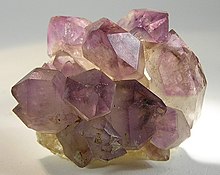
Amethyst specimen from the Reel Mine, Atomic number 26 Station
Denver remained largely a farming community, with cotton as the primary cash crop supplemented by "truck farming" vegetables to area towns (with tomatoes and strawberries being among the nearly often marketed vegetable crops). Members of local families began commuting to work in textile mills in the surrounding communities of Mooresville, Lincolnton, Cornelius, Maiden, and Mount Holly but before Globe War 2, and connected up until the early on 1970s. Having failed to elect a local government for many years, Denver lost its official incorporated condition in 1971 by vote of the state legislature.
Information technology was the filling of a much larger swimming, Lake Norman, that led Denver to grow in ways that its early on boosters probably could have never fathomed. In 1962, Duke Power congenital the Cowans Ford Dam, flooding the fertile farmland along the Catawba River "bottoms", the land which had attracted the expanse's first settlers. Soon, weekend and summer "getaway" homes began to announced lakeside, and after a few years, these were replaced by more than luxurious lake homes, as individuals began to move to the surface area to live almost the water. Denver is now largely a chamber customs for Charlotte, which is 25 miles (twoscore km) to the south.
One of Denver's major features is its "master street", which is now known every bit Erstwhile Highway 16. This road, one time Freeway sixteen, was one of North Carolina's first state highways, receiving that designation in 1928. Present-day Highway 16 is a 4-lane road running forth the southwest edge of the community.
During the 1970s, the town hosted 1 of the largest cross-country motorcycle races in the nation, the "Denver 100", which was a successful fundraiser for the local volunteer fire department. Participants rode through the heart of barns, along creek banks, and through pastures—well-nigh of which have now disappeared nether diverse housing developments.
Up until recently, about African Americans in the area lived in the community known every bit "Little Egypt", which is the general area near East Lincoln High School along Saint James Church Road.
Denver is dwelling to the Rock Springs Campground that has been the site of revivals and military camp meetings since 1794.[6]
Major local industries included modular home builder R-Anell Homes, which recently moved from Denver to a manufacturing facility in Cherryville.
National Register of Historic Places [edit]
The William A. Graham Jr. Subcontract, Munday House, and Rock Springs Camp Coming together Ground are listed on the National Annals of Celebrated Places.[7]
Transportation [edit]

- NC 16 – There are two NC sixteen's that go from northwest to southeast in Denver. The NC 16 going through boondocks is referred to by locals as "Onetime 16" or "16 Business organisation", while the outer route has higher speed limits and is known as "New 16" or "16 Bypass".
- NC 150 – This highway intersects NC 150 at the northwest corner of Denver and leads to Mooresville to the eastward and Maiden and Lincolnton to the west.
Parks [edit]
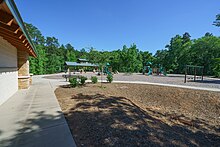
Rock Springs Nature Preserve
- Beatty'due south Ford Park (includes gunkhole access for Lake Norman) – This park includes a picnic shelter, restrooms, disc golf, a walking trail, a volleyball court, horseshoe pits, a splash pad area during summertime months, two children's playgrounds, and an outdoor fireplace.
- Rock Springs Nature Preserve - This newer park in Denver includes a picnic shelter, a large children'southward playground expanse, a partially paved .4 mile trail with a newly carved extended trail through the wood, the trail includes an outdoor classroom and amphitheater.
- Rescue Team Park - Another newer park includes several playing fields, large picnic shelter, modernistic children's playground, Hilly Trail with ix Handbasket Disc Golf Course and is dwelling house to Denver'southward Farmer's Market on Saturdays 8am-12pm (during warmer months).[8]
Education [edit]
Rock Springs Academy, 1 of the original schools in the community, evolved into Stone Springs Schoolhouse, which was a comprehensive 1–12 school until nearby East Lincoln High Schoolhouse was built in 1967. At that time, Rock Springs became an simple school. The original mascot for Rocks Springs was "The Warriors", and the school colors were black and gold; in the 1990s, this was changed to "sailors". The mascot for East Lincoln Loftier Schoolhouse is "The Mustangs", and the school colors are orange and green with the hues irresolute slightly over the years. The bound for which the academy was named lies virtually the Rock Springs Campground on Campground Route.
High schools
- Due east Lincoln Loftier Schoolhouse
- North Lincoln High School (in Lincolnton)
Eye schools
- East Lincoln Middle School (in Iron Station)
- North Lincoln Centre School
Unproblematic schools
- Catawba Springs Unproblematic School
- Rock Springs Elementary School
- St. James Elementary School
Charter schools
- Lincoln Charter Schoolhouse
- West Lake Preparatory Academy
Closed schools include:
- Triangle Unproblematic School – also known as Rock Springs 2 Elementary School (property sold to the Holy Spirit Catholic Church in 1988)
Events [edit]
Town festivals have included the annual Strawberry Festival held in May and the Denver Days[9] festival held every September. Each year, Denver hosts its annual Campsite Meeting at the Rock Springs Campground in the summer, and has washed so since 1794. A Farmers' market is held on Saturdays from mid-April through September at Rock Springs Simple School.
The East Lincoln Betterment Clan[ten] hosts its annual Christmas Parade in Denver every first Saturday of December. The parade route is generally n forth NC Business 16 from Haggers Ferry Rd. and ends but earlier the intersection of Unity Church Rd. and NC Business 16.
Notable people [edit]
- Tony Cloninger, former MLB pitcher and long-time pitching autobus for the New York Yankees
- William Alexander Graham, former U.S. senator, governor of Northward Carolina, and U.South. Secretarial assistant of the Navy
- Jamie Hacking, AMA motorcycle racer
- Kevin Keck, writer
- Adam Scherr, professional person wrestler
- Kingdom of the netherlands Thompson (1873–1940), history professor, pioneered report of the industrializing mail service-Civil War S
NASCAR residents [edit]
- Kyle Busch
- Matt Carter
- Travis Carter
- Jeremy Mayfield
- Matt McCall
- Hank Parker
- Hank Parker, Jr.
- John Reiser
- Ryan Repko
See as well [edit]
- Mountain Air Cargo, a company having its headquarters hither
References [edit]
- ^ "US Board on Geographic Names". U.s. Geological Survey. 2007-10-25. Retrieved 2008-01-31 .
- ^ "Total Population: 2010 Census DEC Summary File 1 (P1), Denver CDP, North Carolina". information.census.gov. U.S. Census Bureau. Retrieved June 29, 2020.
- ^ "U.S. Gazetteer Files: 2019: Places: North Carolina". U.Due south. Census Agency Geography Segmentation . Retrieved June 29, 2020.
- ^ "U.S. Census website". Us Demography Bureau. Retrieved 2008-01-31 .
- ^ Data Access and Dissemination Systems (DADS). "U.S. Demography website". United States Census Agency . Retrieved 23 January 2016.
- ^ "DenverNC Home". Denvernc.com . Retrieved 23 Jan 2016.
- ^ "National Register Information System". National Register of Historic Places. National Park Service. July 9, 2010.
- ^ "Lincoln County NC Parks".
- ^ "2009 Denver Days Autumn Festival". Archived from the original on June 12, 2009. Retrieved June 23, 2009.
- ^ East Lincoln Betterment Association - Christmas Parade
Further reading [edit]
Agosta, Carolyn Steele, "Two Weeks Every Summertime, Stories from Camp Meeting", short stories inspired by Stone Spring Camp Meeting, Denver, NC, and Lincoln County, NC. https://www.carolynsteeleagosta.com
External links [edit]
- Online Guide to Denver

What Is Needed To Register A Vehicle In A Company Name? North Carolina,
Source: https://en.wikipedia.org/wiki/Denver,_North_Carolina
Posted by: escalanteenced1944.blogspot.com
0 Response to "What Is Needed To Register A Vehicle In A Company Name? North Carolina"
Post a Comment